

Why Physical Things Help People Remember Your Brand

A few weeks ago, I drove up to Mendocino with a friend for whale watching season. On the way, she mentioned she thought she’d been there before, years ago in her twenties, for a wedding. She couldn’t remember the details.
Then we pulled into town and drove past a small white church. She got completely animated because suddenly she remembered everything! Not a fragment of memory. Everything. The wedding, the people, the whole weekend. And then, she said to me, “I thought I was there with someone else. But I wasn’t. Now I remember who I actually was with.”
Whoa. She hadn’t just recovered a memory. She had corrected one.
That detail fascinated me. She didn’t remember any of it on the two-hour drive up the coast. It came back the moment she was in that specific place, in front of that specific building. Like the memory had been sitting there the whole time, waiting for her to come back to it.
“Memory is, at a fundamental level, spatial. You remember things by navigating to them.”

I’d been thinking about this when I realized I’d seen something similar play out in branding. It reminded me of a conversation with a different friend from a few months earlier. She was frustrated that people don’t carry business cards anymore. She meets people at events, has real conversations, wants to follow up, and then can’t find them later. Because everything is digital now: an AirDrop, a digital card through an app, a contact saved in the moment. A week later you can’t remember the name, can’t figure out what to search for, can’t recall what the conversation was even about.
The digital version is supposed to be more efficient. More organized. And yet somehow it’s harder to remember the people you’ve actually met.
Both experiences pointed in the same direction. So I started pulling the thread.
Your Brain Has an Address System

In the 1970s, a neuroscientist named John O’Keefe discovered something that eventually won him the Nobel Prize. The brain has dedicated neurons called place cells that fire based on where you are, physically, in space. They function as an internal GPS. Every location you move through, there are neurons tracking it.
What made this more significant was research published in Nature by MIT scientists in 2025. Those same spatial circuits, the ones that track physical location, are recruited for all memory. Not just navigation. The brain doesn’t just use place cells to remember where you parked. It uses them to organize everything that happens to you.
Memory is, at a fundamental level, spatial. You remember things by navigating to them.
In marketing, this idea shows up as brand recall: the ability for someone to remember your business when they need it. We often think of brand recall as something that comes from repetition. But what if it’s also shaped by how the brain stores and retrieves memories in the first place?
The same memory system shows up in everyday life, too. It’s why you walk into a room and forget why you’re there. A researcher at Notre Dame named Gabriel Radvansky spent years studying exactly this. What he found is that it isn’t a glitch in your brain. It’s by design. The brain treats each room as its own memory episode. What you were thinking in the living room belongs to the living room’s context. When you walk through a doorway to the kitchen, the brain opens a new episode, and the old one closes. Going back to where you started works because you’re returning to the right episode.
Now think about a digital contact. A phone number saved after an AirDrop. It has no room. No doorway. No episode. It exists everywhere and nowhere simultaneously. The brain has no architecture to file it in. It isn’t that you have a bad memory. It’s that the digital contact gives your brain nothing to work with.
Physical things have addresses your brain can find. Digital things don’t.
How Computers Had to Fake Physical Space
The people who designed the first personal computer interfaces understood this, even if they didn’t frame it in neuroscience terms. At Xerox PARC in the 1970s, the design team looked at how people naturally organize things in physical offices and built the entire interface as a spatial metaphor. The lead designer said he looked around his physical office and created an icon for everything he saw.

Folders. Files. A desktop. A trash can.
The computer had to pretend to be a physical space to get your brain to cooperate with it.
We’ve been drifting away from that metaphor ever since. Search replaced navigation. Cloud storage replaced visible folders. Infinite feeds replaced anything with a fixed location. As the spatial structure erodes, the brain loses its anchor.
Social media is the extreme end of this drift. A feed has no location. A post appears for a moment and gets replaced. The infinite scroll was specifically designed to remove stopping cues, so the brain keeps going because of what it might find next. There’s never a moment of completion. That’s not a side effect. That’s the mechanism.
Researchers at Princeton published a study in 2018 looking at whether documenting experiences on social media affected how well people later remembered them. The finding was striking: people who posted their experiences into the feed remembered those experiences less clearly than people who didn’t post at all. The act of putting something somewhere online seemed to signal to the brain that it no longer needed to hold on.
The feed may not just be where things go to disappear. It may be actively participating in the forgetting.
“The computer had to pretend to be a physical space to get your brain to cooperate with it.”
Why Gen Z Is Buying Vinyl
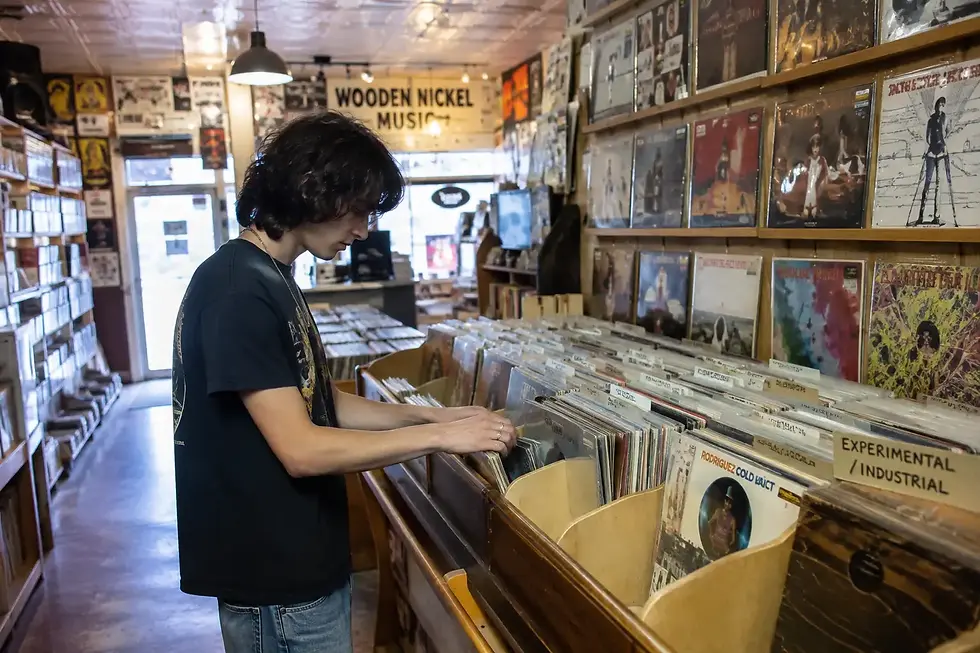
The generation that should be least concerned about any of this, the one that grew up entirely digital, is the generation now choosing physical. Vinyl record sales have grown for eighteen consecutive years. Gen Z is buying them at rates that surprised the music industry, which kept expecting the trend to correct. They’re making zines. Seeking out printed newsletters. Collecting physical books they could read for free on a screen.
Pew Research found in fall 2024 that 44% of US teens say they’ve deliberately cut back on social media or smartphone use, and that number is rising.
This isn’t a nostalgic trend or a cycle. It looks more like recalibration. When the brain is trying to navigate and there’s nothing to navigate to, the pull toward something physical gets stronger. Something physical gives the brain somewhere to go. For a generation that has grown up on virtual feeds, that might just feel satisfying in a way that’s hard to explain.
Embodiment, Authenticity, and What Can’t Be Copied
Kevin Kelly, who helped launch WIRED in the early nineties, wrote an essay in 2008 called “Better Than Free.” He was grappling with the fact that the internet had made it possible to copy almost anything, instantly and for free. So if a perfect copy costs nothing, what’s still worth paying for?
He identified a list of qualities that can’t actually be duplicated. Two of those stuck with me: embodiment and authenticity.
Embodiment means the thing actually exists somewhere. A streamed song file is a copy. A vinyl record is embodiment. An mp3 of a concert is a copy. Being at the concert is embodiment. The digital version has no body. The physical version does, and the body is what gives your brain somewhere to put the memory.
Authenticity means you know it came from the real source. A signed book is worth more than an unsigned one, even though the words are identical. A handmade thing is worth more than a mass-produced knockoff, even when they look the same. People pay for the assurance that something is the real thing, made by a real person, in the real way.
Almost twenty years after that essay, both qualities feel even more relevant now. AI can now generate text, images, strategies, and logos in seconds. Which means the things that took a person, took time, took real human energy to make, are becoming rarer. Not because they’re necessarily better. Because they’re harder to replicate at scale.
How to Help People Remember Your Brand
Embodiment and authenticity are genuinely harder for large companies to manufacture. As a small business, your hands are probably already touching the product. Your process is already personal. The embodiment and the authenticity aren’t a strategy you need to bolt on. They’re just what’s already true about how your business operates.
The question is whether your brand is giving people something they’ll actually remember. That’s one of the places brand clarity becomes surprisingly useful. It helps you notice the moments your customers will carry with them long after the transaction is over.
That might be an unboxing that asks the customer to do something with their hands, so the action becomes part of how they remember your brand, not just the object itself. It might be a handwritten note, a sticker that lives on a laptop for two years, something handed directly to someone in a real conversation at a real event. Something that attaches your brand to a specific moment, in a specific place, with a specific person.
“Something physical gives the brain somewhere to go.”
And because the brain pays particular attention when something breaks the expected pattern, something that arrives unexpectedly creates its own kind of memory.
My friend wasn’t looking for that Mendocino memory. She just happened to be in the right place. That kind of recognition, something that holds the memory of your business for someone until they come back to it, is what intentional brand presence actually means in practice. It’s not about being everywhere. It’s about being somewhere your customer’s brain can find its way back to.
. . .
If you’re ready to think through how your brand shows up in the physical world, the Brand Explorer Workshops are a good place to start.
Why are physical experiences easier to remember than digital ones?
Research suggests that the brain organizes memories around physical places and experiences. Objects, environments, and actions give the brain context to attach memories to, making them easier to retrieve later. Digital experiences often lack those physical cues, which can make them feel more forgettable.
What is brand recall?
Brand recall is a marketing term that describes a person’s ability to remember a business when they need a product or service. It’s often associated with repetition, but memory research suggests that meaningful experiences, physical interactions, and emotional context may also play an important role in helping people remember a brand.
What makes a brand memorable?
A memorable brand gives people something meaningful to hold onto. That might be a distinctive experience, a thoughtful interaction, a physical object, or a moment that feels different from what they expected. Consistency and clarity matter too, because people are more likely to remember brands that communicate who they are in a recognizable and authentic way.
Do you need physical products to create a memorable brand?
Not at all. Physical experiences can take many forms. A handwritten thank-you note, thoughtful packaging, an in-person workshop, a memorable event, or even the way someone interacts with your business can create lasting memories. The goal isn’t simply to add physical objects—it’s to create experiences that give people something meaningful to remember.
How can a small business create a more memorable brand?
Start by understanding what makes your business genuinely different. A memorable brand isn’t built through clever marketing alone. It grows from brand clarity, consistent experiences, and authentic interactions that reflect who you are and what you stand for. Once that foundation is clear, it’s much easier to create moments that customers remember and want to share.

Comments